Showing posts with label 2013. Show all posts

Thursday, July 26, 2012

The AMNH: Manhattan's Shabbiest Museum


        It occupies an 18-acre plot of land.  It comprises over two dozen buildings, some barely visible anymore, in a mishmash of architectural styles.  It houses various laboratories, a gigantic library, and rundown, labyrinthine, and poorly lit corridors strewn with skeletons and preserved animal specimens.  Much of it has been neither updated nor renovated--nor perhaps even simply dusted--in decades.  It's not the vast, ramshackle estate of a mad scientist in a horror film.  It's the American Museum of Natural History on the Upper West Side.
Those who point out declining public and federal interest in such institutions may blame a lack of upkeep funds.  A postmodern apologist for the AMNH's current state may advance the theory that the museum as a whole, by allowing much of itself to decay in an almost organic manner, is intentionally becoming one of its own exhibits.  However, the simplest and most compelling explanation is an old adage slightly modified:  "If nobody cares that it's broke, don't fix it."
In spite of rampant dilapidation, the AMNH attracts a stampede of nearly 14,000 visitors a day, or approximately 5 million yearly.  The Metropolitan Museum of Art, the only New York museum to top the AMNH in number of visitors, leads by only a small margin of about 4.8%.  Manhattan's Museum of Modern Art and Guggenheim are comparatively deserted, drawing in approximately 2.5 million and 1.1 million visitors per year, respectively, in spite of their being more interesting and culturally relevant (and less depressing).
As at other museums, permanent installations account for the bulk (by our estimation 85%) of the AMNH's public offerings.  These are augmented by special exhibitions that change periodically.  Currently, the museum boasts 45 exhibit halls and six special exhibitions (one is an IMAX movie, another a space documentary narrated by astronomer Whoopi Goldberg).
Of course, only the regular displays are included with general admission tickets (suggested price:  $19).  It costs extra to see any of the special exhibits, implying that the permanent displays are the raison d'être of the American Museum of Natural History.  "If you see nothing else," the ticket pricing structure seems to implore, "at least see those."
Upon entering the museum through an imposing Neo-Classical façade located a flight of stairs above street level on Central Park West, you have begun an experience that will prove by turns exhausting, depressing, disappointing, and disorienting.
The main entrance hall--the Theodore Roosevelt Rotunda--is a cavernous, sun-drenched room filled with the deafening buzz of hundreds of tourists, their multilingual shouts reverberating in the vast chamber.  After navigating the throng, standing in line for several minutes, and shelling out money for a ticket, you pass into "Asian Mammals," whereupon you must pause for several seconds and adjust to the suddenly tomblike ambience.  Once acclimated to the gloomy silence and crepuscular lighting, you are ready to commence a grim odyssey through hall after dilapidated hall, floor after rundown floor, of begrimed installations, crumbling dioramas, and criminally outdated graphic design.
In spite of the museum's impressive attendance numbers, many of the exhibition halls seem curiously bereft of browsers.  When somebody is spotted, he is often plodding mechanically from one end of a gallery to the other, robotically going through the motions, never really examining any of the displays.  As a result, the studious patron has the opportunity to be rewarded (or punished) with an undisturbed, close-up look at each exhibition room.
During your dreary pilgrimage through the museum, you will make certain observations about the galleries, such as that many are festooned with discarded pamphlets, food wrappers, remnants of industrial adhesive tape, and other assorted ephemera.  You will notice unpleasant odors and sudden temperature shifts.  You will see halfheartedly repaired floors, flaking paint, dust-coated windows, and illogically placed pieces of random furniture.  Once you begin inspecting the installations, you will see desiccated landscapes, crudely constructed replicas of flora and fauna, discolored acrylic "ponds," lazy special effects, and hopelessly démodé typography, all of which are often displayed in dioramas.  These dioramas are frequently fading, disintegrating, or incomplete.  They are always lifeless and pedantic.
      This is a museum that boasts many attendees (most of whom pay the full suggested admission), a sizable endowment (its financial records are available for the public, visible through a simple web search), and starring roles in Hollywood movies (e.g., Night at the Museum).   It sounds glamorous and fabulous, but let's get down to brass tacks and take a look at what you, the museum patron, will really see during your visit.

^The Museum meant to depict a stream, but what remains now is nothing more than a rust-stained trench (suggesting not only poor exhibit maintenance, but also high iron content in the water that once ran through this tableau).  

^The Museum's Grand Gallery as captured by this CRABNOX reporter.  Subsequent visits to the Grand Gallery confirmed that it tends to be bereft of patrons.  At the time this image was captured, the opposite side of the Grand Gallery featured an impressive natural mineral sample as well as an empty garment rack.

^Like many exhibit halls in the AMNH, this one features poorly maintained floors and a lack of viewers.


^On a display card, a reference to insects fails to explain the strange grey substance covering a fake apple.  The reference to insects is rendered all the more confusing by the lack of any depiction of insects in the display.  


^The AMNH often relies upon on diner-style typography.


^This image depicts one of the AMNH's most prized diamond specimens.  Unfortunately, the stone is hard to discern since the Museum decided to place it against a yellowing swatch of carpet-like synthetic material.

^Relief map showing the principal environmental areas which influence the distribution of animal life.  This relief map also displays cracks, tears, and smoke stains.


^The AMNH has a curious sense of time.  For instance, it continues to display as "recent acquisitions" items obtained nearly a decade ago.  

^Some sort of chemical reaction or mineral degradation is occurring here.  The AMNH does not seem concerned that one of its mineral specimens is leaking a substance curiously similar to the powdery cheese substance packed in boxes of Kraft macaroni products.  

^Many exhibits--a significant number of them--are disgracefully titled with cut-out cardboard letters attached to the walls of the museum with small nails.


^Always on the bleeding edge of farm technology, the AMNH shows us the "modern farmer."  This caption, prominently displayed, accompanies a depiction of a man riding a tractor and is dated 1950.  

^The Museum's depiction of the natural history of Asia involves a swami floating on a magic carpet (convincingly rendered with special effects).


^An unauthorized photograph (flashes forbidden!) captures the decor of the AMNH.  


Thursday, February 24, 2011

Product Label Analysis


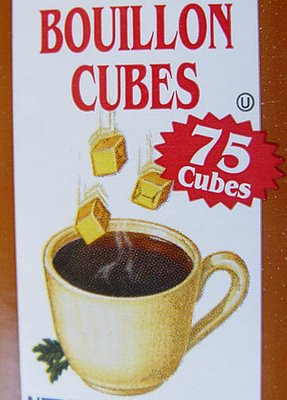
Pictured here is label found on Spice Select's "BEEF Flavored BOUILLON CUBES".  We shall demonstrate the success of the package's design through an examination and analysis of the complex illustration seen on the front of the label.

The complexity of the label's design lies in its brilliantly devised depiction of several distinct periods of time within a single image. The illustrator has achieved the closest approximation of a moving image (e.g., a television ad) possible with a static, two-dimensional label illustration. The result is a narrative describing the entire process of consuming the bouillon cubes, from start to finish. Unlike a moving image or series of still images (e.g., a multi-panel ad), the bouillon cube illustration simultaneously presents four separate events or states that would normally occur over a period of perhaps ten or more minutes.

The normal preparation of bouillon cubes can be summarized by describing a linear sequence of events; for example: 1) foil removed from cube(s); 2) cube(s) added to preparation vessel; 3) finished gravy mixture added to serving vessel; 4) filled serving vessel garnished and added to table.

However, in the Spice Selects image, these four events occur in the same instant. In the image, three cubes remain in their foil wrappers, representing the state of the cubes after purchase and before consumption; the foil also ascribes a quality of newness to the cubes. However, in spite of being new and unwrapped, the cubes are already being put to use: they are in the process of tumbling (with tremendous speed, incidentally) toward a waiting vessel. But the vessel contains gravy that is already prepared and adding another cube to the mixture would unfavorably alter the taste; adding three would ruin it completely (the depiction of so many cubes, in such close proximity to the jubilant "75 Cubes" claim, is probably meant to evoke the bounty offered by this 10.5 ounce container). It is important to remark that the addition of these cubes to the existing mixture is not being shown as a attempt to improve the flavor of the mixture; note that the vessel is full with no traces of its having even been sampled. Furthermore, the gravy is already in a mug (serving vessel), not a saucepan (preparation vessel); that and the parsley sprig garnish underneath it imply that the gravy has been satisfactorily prepared and that the mug itself has already been presented for use on a dining table.

To attempt to explain this image as a depiction of a single moment would require creating a convoluted backstory. For instance: the consumer prepared some gravy and, apparently satisfied with the result, poured it into a mug; he placed a decorative sprig of parsley on the table and put the full mug on top of it; however, seconds later, the gravy still steaming and unsampled, he somehow determined the gravy was not satisfactorily prepared after all; he decided to add an astonishing three cubes to that 8-ounce mug of gravy (for which quantity just one cube is recommended by the label's instructions) but after removing the cubes from the package, failed to unwrap them; and now, in the image before us, we see the consumer's frenzied act of adding three unwrapped cubes to an already prepared and presented vessel of gravy (probably before the astonished eyes of other dinner guests, as an 8-ounce mug of gravy is too large a quantity to be consumed by the average diner).

Conversely, to regard the image as an overlapping series of separate events gives us a satisfactory result. With one quick glance, we witness the entire process of preparing gravy using Spice Select's product. From the metallic allure of fresh, unwrapped cubes to the promise of the rich flavor offered by the filled and garnished mug, the entire sequence is presented to us at once, which has the added benefit of implying ease and quickness of preparation. We can compare this simultaneous representation of temporally separate events to one of Picasso's Cubist paintings, wherein we might see the subject's face depicted from several different angles at once.

The Crabnox Insta-title


Have you completed a film but stalled out on creating a title? If so, your worries are over. With its new INSTA-TITLE, CRABNOX makes that most difficult aspect of movie production easy. Simply take any word from the first box and any word from the second box, and you have the perfect title. The word banks contain vague entries that can signify almost anything, which means that regardless of your film's genre, the INSTA-TITLE will give you an appropriate appellation.  


Ready for the sequel? Take your film's title, add "2:" to the end, and follow the steps above with the word banks below.  For more important sequels, we recommend using "II:" instead.


Here are some samples to get you started:
Unintended Sacrifices 
Unintended Sacrifices 2: The Other Side of Madness 
Secret Moments  
Secret Moments 2: On the Verge of Tomorrow
Forbidden Vengeance
Forbidden Vengeance II:  Brink of Insanity


Tuesday, October 26, 2010

Defining the "Classics"


Spaghetti and meatballs. Shepard's pie. Mashed potatoes and gravy.  And "Tortilla Crusted Fish"? While the first three menu options are self-evident classics-traditional dishes that have been prepared the same way for generations-the fourth item is one of countless new products being dubbed "classic" by its manufacturer. The spate of nouveaux classics in grocery aisles led Crabnox to wonder what criteria are being used to deem them so. We ignored that these products are all suspiciously self-described as such (indeed, in a nod to the fact that Coca-Cola is a world-recognized classic, the company recently began the process of eliminating that superfluous label from its products and promotions). Crabnox food investigator Professor Krumsville sent a letter (see below) to several corporations to query about these products and found many interesting claims. In some cases, a product is a classic if it reinforces gender stereotypes. In others, the term refers to an item's poor quality.

Professor Krumsville used the following template for his letters to various manufacturers:

Dear Sir or Madam,

I am interested in your [brand name] line of products, especially the [classic product name]. Can you please explain, in detail, why these [items] are "classics"? Do they have "modern" or "contemporary" counterparts?

I am very interested in buying the product, but first require more information about the "classic" aspect.

I am eagerly awaiting your reply.

Sincerely,

Professor Krumsville

Below are the four products Professor Krumsville inquired about, along with the corporate responses and analyses by Crabnox. Note: errors in the corporate responses (such as exotic capitalization and non-traditional punctuation) added a humantistic touch to the faceless email replies Professor Krumsville received and are preserved below.

Case Study 1: Spice Classics


Products: Various inexpensive, mostly salt-based spices and seasonings, including poultry seasoning, seasoned salt, garlic salt, light chili powder, and celery salt.

Corporate Response:
Dear Mr. Krumsville:

Thank you for taking the time to contact us. We appreciate your interest in our Spice Classics Product and welcome the opportunity to be of assistance to you.

Spice Classics is the name we have given to one of our lower quality line of spices and it contains only the most popular spices and blends used by consumers. Most have a shorter shelf life and may not impart the same depth of flavor as our regular and premium line of McCormick Spices. These can be found in Drug Stores and many 99 cents stores.

We hope to have the continued pleasure of serving you.

Sincerely,
Ann Hamilton
Consumer Affairs Administrator
Ref # 1252236

Analysis: Like Edsel, Ford's 1950s bomb that became a dubious classic by virtue of its faulty craftsmanship, Spice Classics are, according to Consumer Affairs Administrator Ann Hamiliton, so-named because of their shoddy quality.  That and their popularity have won them status as downmarket staples. McCormick does not conceal the fact that the flavor dissipates rapidly and the products can be found at low-end retail outlets. Although several of the various seasonings are admittedly classics (such as ground black pepper), Crabnox found it curious that McCormick was so eager to explain the aspect of inferiority. A crafty marketing maneuver calculated to promote their higher-end spice lines? Or a resigned admission of what the world already knows?

Unexplained Aspect of Product: That such basic spices have less flavor and shelf life. What is McCormick doing or not doing to Spice Classics black pepper that renders it weaker in taste and condemns it to an earlier shelf death than "regular" and "premium" black pepper?

Case Study 2: Stouffer's Homestyle Classics

Products: Various frozen meals.

Corporate Response:
Dear Mr. Krumsville,

Thank you for taking the time to contact us about STOUFFER'S® Escalloped Chicken & Noodles. We welcome questions and comments from loyal consumers such as yourself and appreciate this opportunity to assist you.

We have researched your inquiry and STOUFFER’S® Homestyle Classics- Escalloped Chicken & Noodles is a creamy casserole dish consisting of white meat chicken, fettuccine egg noodles, and vegetables; topped with toasted bread crumbs. It is a Homestyle dinner because it is the type of casserole a mom would make at home versus a restaurant style meal. It is a classic meal because it falls in our traditional, 'homestyle' American favorites.

We appreciate your interest in our products and hope you will visit our website often for the latest information on our products and promotions.

Sincerely,

Roxanne Rizzo
Consumer Response Representative


Analysis: Consumer Response Representative Roxanne Rizzo responded directly about "Escalloped Chicken & Noodles", although Professor Krumsville did not ask about a specific meal from the Homestyle Classics product line. The most interesting point Rizzo makes is that this is the "type of casserole a mom would make at home." In other words, and according to what Rizzo "researched", it is a homestyle meal because it upholds the stereotype of the 1950s stay-at-home mom who toils all day to prepare a meal for the rest of her nuclear family. And because it is a homestyle meal, Ms. Rizzo claims, it is a classic. Therefore, it is a classic because it sets back the women's liberation movement several decades.

Possible Follow-up Questions: If prepared by a member of the transsexual community, do these Stouffer's meals lose their "classic" status? Can nations where women are forbidden to vote be considered "classic countries" because they support the view that women should have limited rights?

Case Study 3: Progresso Vegetable Classics

Products: Canned soups in a variety of flavors, including macaroni and bean, creamy mushroom, and 99% fat free lentil.

Corporate Response:
Hello Mr. Krumsville:
Thank you for contacting Progresso with your inquiry. In answer to your question, the Progresso Vegetable Classics are the name of our soups that are mainly vegetables and were some of the first soups Progresso ever manufactured. We have several lines of Progresso Soups from the Vegetable Classics to the Progresso Lite line of soups. Please visit our website to see the many soups we have.

We hope you find this information helpful. Please let us know if we can help you again.

Thank you,

Paula A. Vaughn
Customer Care Specialist

Analysis: Paula Vaughn, the specialist assigned by Progresso to this case, provided the seemingly most appropriate definition of classics: products that the company has made since its inception. However, Crabnox wonders if 99% fat free options even existed 100 years ago, when Progresso first started out. Additionally, were ingredients such as granular cheese, corn protein (hydrolized), potassium chloride, and Diacetyl Tartaric (Acid) Ester of Monoglyceride, all components of various Vegetable Classics, really used in some of "the first soups Progresso ever manufactured?"

Most Plaintive Moment of Corporate Response: "Please visit our website to see the many soups we have."

Case Study 4: Pantene Pro-V Classic Care

Products: Various hair cleansing and treatment solutions, including a "2 in 1" shampoo and conditioner.

Corporate Response: Pending (281 days and counting).

Possible Explanation of "Classic" Status: Per the label: the product "cleans and conditions hair in one easy step: is specially designed to make hair shiny and healthy-looking from root to tip; leaves hair manageable and strong against damage". Curiously, though, no "step" (i.e., specific action to be undertaken by the end user) is actually disclosed. The label also pronounces authoritatively that "You have normal hair," and subsequently decrees that "You want strong and healthy hair that shines."

Monday, October 25, 2010

The Snuggle Bear Found Murdered

AP-In the early hours of the morning, beloved anthropomorphic detergent spokesmammal the Snuggle Bear was found brutally murdered in an alley in Manhattan's Hell's Kitchen neighborhood. While authorities have few leads, the slaying may have resulted from a drug deal gone awry. According to a family friend, the Snuggle Bear became addicted to crystal meth and cocaine after he lost his personal fortune financing "Alien vs the Snuggle Bear," his big-screen debut, which proved a massive critical and commercial failure. "He was a broken bear," the friend confided. "When he couldn't make it in Hollywood, drugs became his only escape." At this time, no suspects have been named. The Snuggle Bear was 52 bear years old.


Above: at the pinnacle of his career, the Snuggle Bear was one of the world's highest paid ursine media personalities.

Above: the slain corpse of the Snuggle Bear.